
Summer of Solidarity in Cyprus: more time, more love, more listening
"Kimia means peace and quiet," Christine tells me, gently trying to soothe her restless, screaming two-year-old son. She repeats it again—Kimia.
Christine is from the Democratic Republic of the Congo. She arrived in Cyprus only a few weeks ago, after spending more than two years in Turkey. Her story is one of long journeys, quiet resilience, and remarkable endurance. When Christine says her son’s name and looks at him, her eyes reflect both painful memories and a fragile hope for the future.

In early August, I travelled to Cyprus with friends from the Community of Sant’Egidio. The sun shone every day we were there, but we didn’t come for the weather. We came to support the work of the Community in the refugee camps of Pournara and Kofinou, where hundreds of men, women, and children wait—for papers, for safety, for recognition, for a future.
I had read about these places. I watched the documentaries, listened to the podcasts. But none of that prepared me for the barren, oppressive atmosphere of Pournara, more like a prison than a first reception centre for asylum seekers. Or the smell of Kofinou, the refugee camp built on a sewage line.
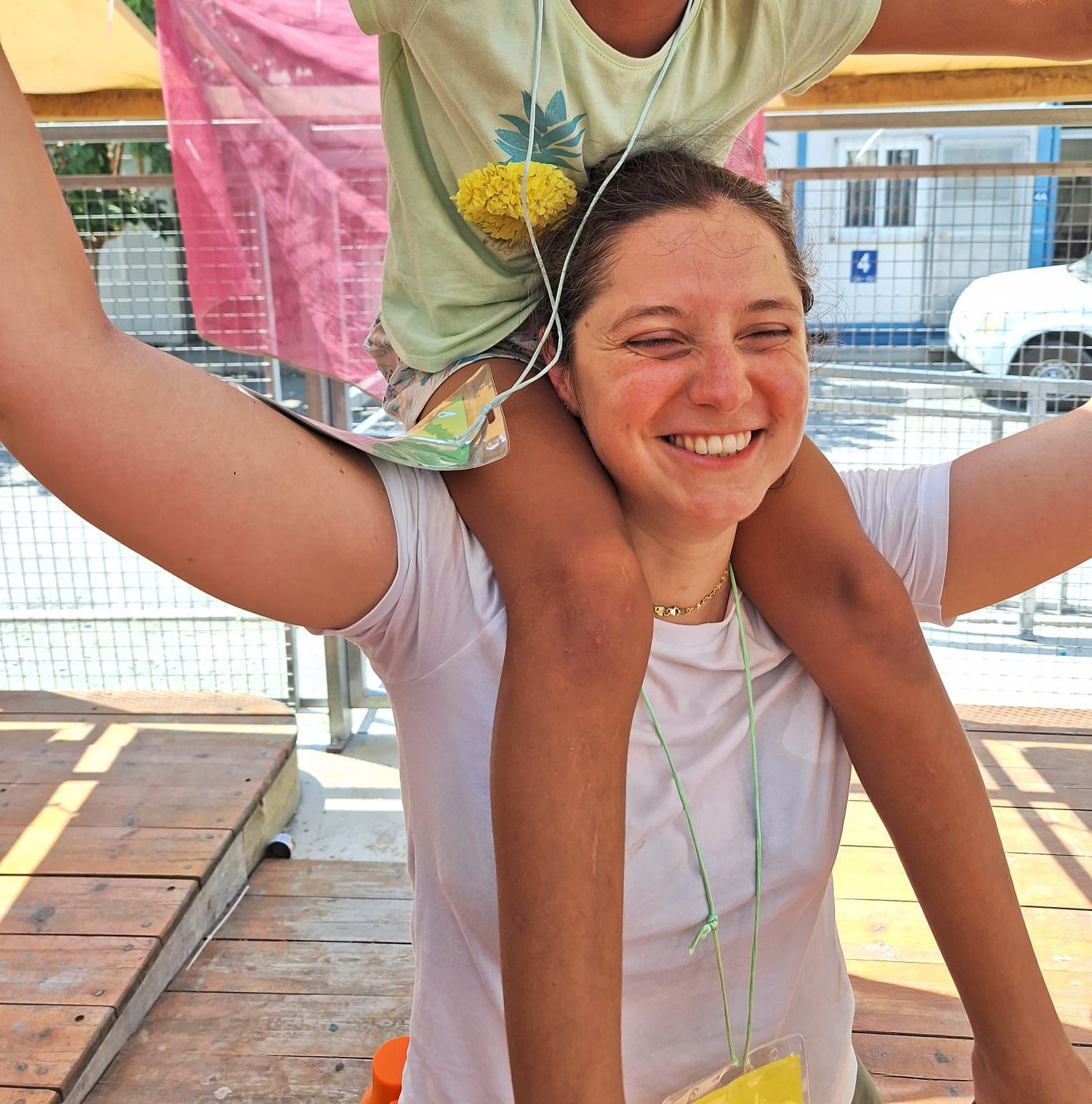
Each morning, members of Sant’Egidio split up and scattered across the island. Some of us went to Kofinou, where the youngest members of our group, the Youth for Peace, ran the School of Peace for children who had already seen too much in their young lives. Others stayed in Nicosia to teach English. Mothers would arrive pushing prams, holding their children’s hands. The Community cared for these kids so the mothers could focus on learning.
In the afternoons, we travelled to Pournara. The rhythm became familiar: English classes, School of Peace, filling with water the inflatable pools so the children can play there and get a relief from the heat. Some of us prepared the Tent of Solidarity—wiping dust off tables, placing flowers, getting ready to serve dinner. And then, as the sun dipped low and the air cooled, something beautiful happened. Our friends arrived, we shared a meal, and we got to know each other. We exchanged Instagram accounts and stories about who we are and what we hope for.
After dinner came our fiesta. Someone would put on music. Hands clapped, drums were played, and slowly, shyly at first, people danced—Afghani steps, Congolese rhythms, Syrian clapping songs. Volunteers and residents, strangers and new friends, dancing together, until the lines between us faded like the horizon at sunset.
You might think the day ended there. But in true Sant’Egidio fashion, there was always more—more time, more love, more listening. On the bus back to Nicosia, and over dinner, we’d share stories from the day. Faces came alive in our conversations: the little Somali girl who always asked for more sweets (and got them!), the teenage boys who wanted to eat quickly so they could play football, everyone asking for more chilli and lemon, the mothers who smiled as we held their babies so they could eat in peace.
These are the memories I brought home—not statistics, not headlines, but faces and stories.
"Why did you go?" I'm often asked now that I’m back. At first, I wasn’t sure how to answer.
But now I am: I went to meet each of them.


Comments